
Custom Jewelry Manufacturer for Brands: Ten Things to Confirm
Ten confirmations separate a factory that can carry your launch from one that cannot. Hold each of them against published numbers: 50 pieces minimum per design in 925 sterling silver, a 25–30 day master sampling window, and 3–4 weeks of bulk production once the sample is signed off. Work the list in order, before any purchase order leaves your desk.

Key takeaways
- Minimums run 100 plus in stainless steel, 100 pieces in artisan brass and 50 pieces in sterling silver, per design, so a two-design range doubles those figures.
- 3D CAD comes back inside 48 hours, the master sample takes 25–30 days, and bulk production adds 3–4 weeks.
- Eight documented factory steps end with 100% inspection; REACH compliance on lead, cadmium and nickel, ISO 9001:2015 and a BSCI audit.
- Ownership terms come first: 100% NDA keeps moulds, CAD files and the collection exclusive to your brand.
Confirm the minimum before you confirm the design
A first order lives or dies on the smallest quantity a factory will tool, and that number is set by how the piece is made rather than by how much the buyer is liked. Casting silver is the shortest route on the floor, which is why artisan brass with recycled content, 925 sterling silver and stainless steel is machined rather than cast and usually finished in a PVD vacuum chamber, so it starts at 100+.
Multiply the minimum across your launch. Three silver designs need 150 pieces in total; the same three shapes in brass need 300. Write that total down before the design review, because it is the figure your cash flow has to cover and the first one a new brand regrets ignoring.
Put the material and finish pair in writing
The finish list: gold in 14K, 18K and 24K, plus rhodium, then a protective anti-tarnish e-coat on silver and brass and vacuum PVD plating on stainless steel. Ask a custom fashion jewelry supplier to write that combination into the spec sheet rather than into an email thread, because gold-plated brass and gold-plated silver with an anti-tarnish layer are two products with two sets of care instructions.
Hallmarks belong in the same paragraph as the finish. a 316L mark on steel, an S925 stamp and 18KGP on gold-plated work are the three purity marks the factory engraves, applied by high-precision laser engraving along with any logo or lettering the piece carries.
Five figures worth putting on a single page
Most first enquiries fail on missing information rather than on price. Put the quantities, the windows and the tooling route on one page and the reply from TTT Jewelry becomes technical instead of vague.
| Confirmation point | Published figure | What it decides |
|---|---|---|
| 925 sterling silver minimum | 50 pcs per design | Smallest silver run worth tooling |
| Artisan eco-brass minimum | 100 pcs per design | Size of a first plated run |
| Stainless steel minimum | 100+ pcs per design | Whether PVD finishing makes sense |
| Master physical sampling | 25–30 days | Launch date once CAD is approved |
| Mass production | 3–4 weeks | Repeat-order planning |
Check your calendar against the sampling window
Sampling is not one event. Across 25–30 days the factory runs wax printing, mould casting, stone setting, polishing and electroplating, and a change of mind during that stretch restarts a pass rather than nudging it. The stage brands under-plan is the one after approval: 3–4 weeks of mass production, with packing and shipping stacked on top.
Three dates belong on your calendar, and only two of them are quoted. CAD sign-off, sample approval, and the day the sample actually left the bench. The gap between the last two tells you how a quoted window behaves when the design is unusual, which is exactly when you need to know.
Read the compliance documents, not the adjectives
Three documents are worth asking for by name. The first is the ISO 9001:2015 quality management certificate, which describes a system that documents its process and repeats it. The second is the BSCI audit report, which speaks to labour practices and supply-chain conduct. The third is the materials statement behind REACH compliance, covering lead, cadmium and nickel, with the plating stack declared under the same heading.
None of the three says a piece is beautiful, and none of them mentions price. What they do is tell you what to ask for when a claim appears on a website: a certificate number, an audit date, and the restricted-substances list the materials were checked against.
Ask who owns the mould and the CAD file
The quiet question in every OEM/ODM arrangement is ownership of the tooling. Moulds, CAD geometry and a co-developed collection can be reused for other buyers, or they can be exclusively yours. The published position is 100% NDA with designs that stay exclusive to the buyer's brand, which covers all three assets at once.
This is the confirmation that protects the other nine, because it is the only one that still matters after the project ends.
Worked example: ten checks inside a seven-to-nine week calendar
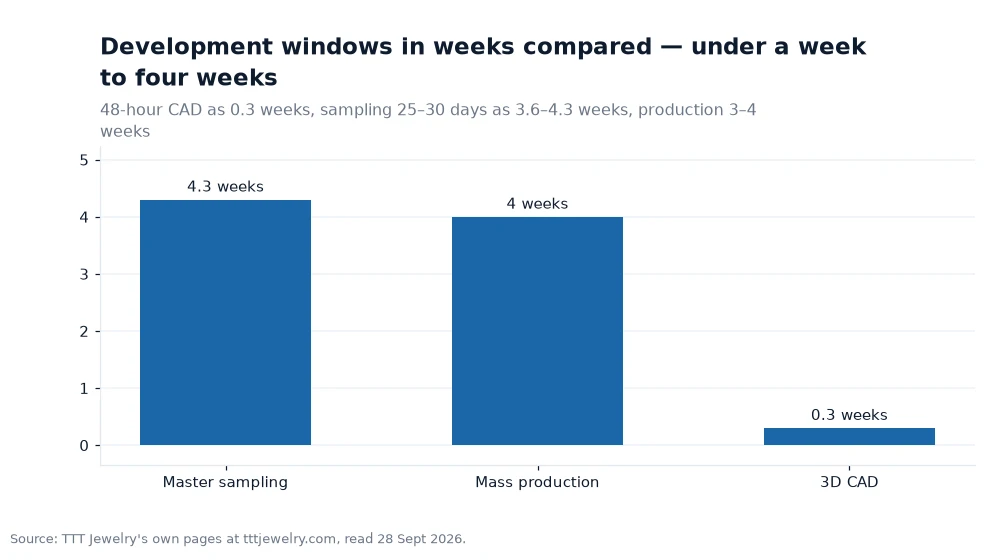
Convert the three published durations into one unit and the whole schedule appears. CAD is under 48 hours, which is under two days, so about 0.3 of a week. Sampling is 25–30 days: 25 ÷ 7 = 3.6 weeks at the fast end and 30 ÷ 7 = 4.3 weeks at the slow end. Production is already quoted in weeks, 3 to 4.
Add the slow end of every stage: 0.3 + 4.3 + 4 = 8.6 weeks. Add the fast end: 0.3 + 3.6 + 3 = 6.9 weeks. The planning band is therefore about seven to nine weeks from CAD to shipped carton, plus however long you take to approve each gate. That arithmetic is mine; the four durations being converted are the manufacturer's.
Frequently asked questions
What should a brand confirm first with a factory?
The published minimums are 100 units in artisan eco-brass, 100 plus in stainless work and 50 in sterling silver, per design.
How do I verify the compliance claims?
Ask for the ISO 9001:2015 certificate, the BSCI audit report and the REACH materials statement naming lead, cadmium and nickel, then read the dates and scope on those documents rather than the badges on a website.
Who keeps the mould once the project ends?
Under the published terms the buyer's designs stay exclusive: 100% NDA covers the moulds, the CAD files and the collection, so none of the three is resold or shown to another brand.
Ten answers, one decision
Work the list in order and the choice narrows quickly. If the minimum fits your first run, the finish route is written into the spec and all three documents exist, what remains is your own calendar. Brands that arrive with a finished CAD file take the OEM route, where the buyer owns the design and the factory produces it; brands that arrive with a mood board take the ODM route, where the collection is developed with the manufacturer's own design team. Both routes are set out side by side on the OEM and ODM services page, and the piece types inside each material line are grouped under wholesale collections.
The basis for every figure above — the 100% NDA terms as well as the eight-step production route and the laser engraving stage — is the manufacturer's own pages through tttjewelry.com, per a read on 28 Sept 2026. Nothing else here is inferred. The derived numbers rather than the published ones are my own, while the source figures stay the client's[1].