
A custom fragrance programme runs for years, so the terms that matter most are the ones nobody discusses while the first sample is exciting. Ownership, testing responsibility, minimum volumes, price validity and the exit position all have cheap answers at the start and expensive ones after a product is selling. The nine questions below are arranged in the order a brand should ask them, and the section after the list explains what a useful answer looks like compared with a reassuring one.
Key takeaways
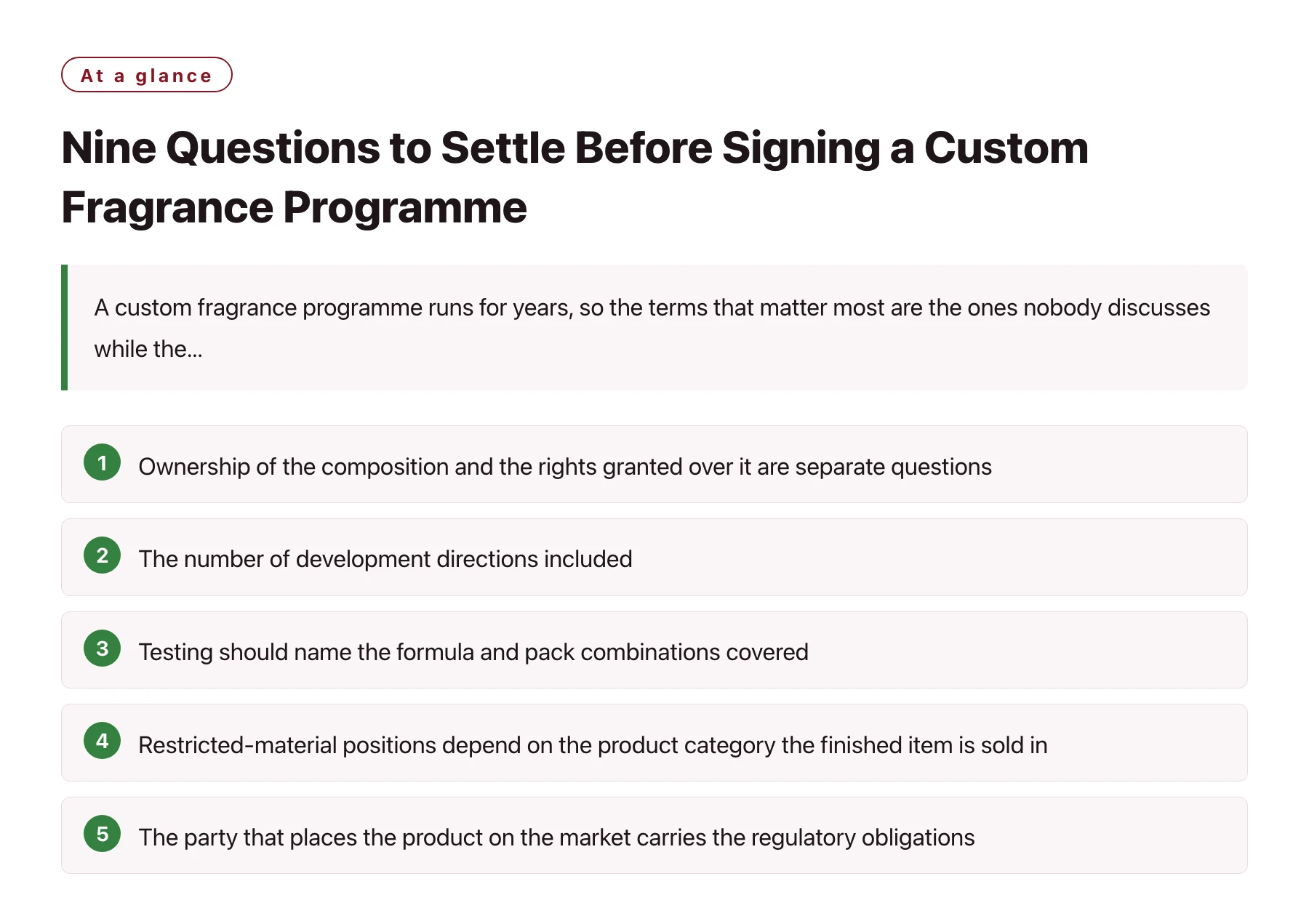
- Ownership of the composition and the rights granted over it are separate questions, and a development fee does not by itself transfer either one [1].
- The number of development directions included, and the cost of exceeding them, defines the commercial shape of the project more than any other clause.
- Testing should name the formula and pack combinations covered, the laboratory used and who pays for repeats, because an unnamed test package is not a commitment [2].
- Restricted-material positions depend on the product category the finished item is sold in, so the review belongs before the scent is approved rather than after [3].
- The party that places the product on the market carries the regulatory obligations, which for most subscription brands means the brand even when the factory developed the formula [4].
- Exit terms matter on the day the programme starts, not on the day it ends, because a brand that cannot move production has less negotiating power at every renewal.
Negotiation timing is asymmetric. Before a sample exists, both sides are flexible and clauses are cheap to discuss. Once a scent has been approved internally and a launch date has been announced, every change becomes a concession, and the brand's leverage is at its lowest.
Subscription businesses feel this more sharply than most, because the value of the product accumulates over time. A brand that owns its formula, holds its test evidence and can move production has an asset; one that depends on a single supplier for the composition, the paperwork and the price has a dependency.
The nine questions below are the ones that decide which of those two positions a programme ends up in. They are all answerable in a single call, and none of them require technical expertise to evaluate.
The nine questions, in the order that matters
- What does the development fee include: how many scent directions, how many refinement rounds, and what happens when those are used up?
- Who owns the composition, what rights does the brand receive, and do those rights survive a change of supplier or of ownership on either side [1]?
- What happens commercially if every direction is rejected, and is any part of the fee credited against a later order?
- Which formula and pack combinations will be tested, by which laboratory, at whose cost, and what evidence does the brand receive? [2]
- What is the restricted-material position of the chosen formula for the category the product will be sold in, who monitors changes, and how are updates notified? [3]
- What is the minimum order quantity, how was it derived, and does it differ for a first order and a reorder?
- How long is the quoted price valid, and what is permitted to move it: material costs, exchange rates, volume, or a change in the specification?
- What does the brand receive when development ends: a formula record, a sealed reference from the approved batch, test reports and the labelling inputs for each market?
- What are the exit terms, including notice period, the position on work in progress, and whether production can be transferred to another site [4]?
How to read the answers
A useful answer names a person, a document or a number. A reassurance names none of those. That single distinction sorts responses faster than any scoring system, and it holds across every question on the list. It applies equally to the general the checks that matter before signing a contract that hold for any supplier relationship, not only for fragrance development.
It is also worth separating the questions into two groups: those that protect the launch and those that protect the years after it. Rounds, testing and material positions protect the launch. Ownership, price validity and exit terms protect everything that follows, and they are the ones most often left vague because they have no immediate consequence.
Where a supplier can reasonably be flexible
Payment staging, delivery terms, packaging details and the number of included rounds are all normal subjects for negotiation, and a supplier that will not move on any of them is either rigid or heavily booked. A buyer who spends the negotiation on these points and leaves ownership untouched has optimised the small items.
Where a brand should not accept ambiguity
Three answers have to be unambiguous: who owns the composition, who holds the test evidence, and what happens if the brand wants to produce elsewhere. A programme with clear answers to those three can absorb a lot of ordinary friction, and one without them is exposed at exactly the moment it succeeds. It is worth reading Learn more about how a manufacturer stages development before the call, since a published process makes these questions easier to frame.
Two questions worth asking twice
Two of the nine answers deserve a repeat later in the conversation, phrased differently. Ask again who owns the composition, this time in terms of what the brand could actually do with it if the relationship ended, and ask again what happens if a material in the chosen formula becomes restricted. Suppliers that answer consistently on both occasions are describing a position they hold rather than a position they improvise, and the repeat costs nothing.
Two practical habits make this list more effective. First, send it in writing before the call, so the answers are considered rather than improvised. Second, ask a follow-up question on any answer that does not name a document, a person or a number, because that is where the real position of the programme sits. A supplier that expects to work as a scent development and manufacturing partner over several years should welcome the questions, and the way they are answered is itself part of the evaluation.
Sources
- WIPO — World Intellectual Property Organization —— The UN agency for intellectual property; resources on industrial design and patent protection relevant to product and packaging design.
- SGS: Cosmetics, Personal Care & Household Testing —— Testing, inspection and certification services for cosmetics and personal care, including microbiological, stability and safety testing aligned with cosmetics GMP.
- IFRA Standards Library (International Fragrance Association) —— The IFRA Standards Library lists the restrictions the fragrance industry applies to individual fragrance ingredients, based on safety assessments; it is the reference point for compliant fragrance formulation.
- European Commission: Cosmetics in the EU —— The European Commission's overview of EU cosmetics rules, including the responsible person, product information file and safety report requirements.
Frequently asked questions
Should a brand pay a development fee at all?
Often yes, since development consumes perfumer time and materials. What matters is what the fee buys: a stated number of directions and rounds, clarity on what happens when they are used, and whether any part is credited against a later production order. A fee with no defined output is difficult to evaluate.
Is it better to own the formula outright?
Ownership gives the most control and usually costs more, either in a higher development fee or in a higher unit price. Rights to use the composition exclusively in a defined field can be sufficient for many brands. The decision depends on whether the scent is intended to be a long-term asset, which for a subscription business it usually is.
What if the factory will not discuss minimum order quantity flexibility?
Minimums are often driven by real constraints such as batch size, material minimums or line setup, so a firm position is not automatically a problem. What is reasonable to ask for is the derivation: which component or process sets the floor, and whether a higher price can lower the volume for a first order.
How long should price validity be?
Long enough to cover the development period plus a production cycle, and stated in writing along with the factors that can change it. Anything shorter leaves a brand exposed between approval and order, and anything undefined is not a validity period at all.
What documents should be handed over at the end of development?
A formula record with the version in production, a sealed retained reference from the approved batch, test reports naming the versions tested, and the labelling inputs derived from the formula. Together they make the scent portable, which is what turns a development project into an asset.